Breakfast for Two: A Scaling Guide
- Start with the yield, not the ingredient list
- Calculate one factor and use it everywhere
- Which breakfast recipes halve cleanly?
- How do you halve one egg?
- Should baking powder and baking soda be rounded?
- Pick a pan that fits the new amount
- Do temperature and cooking time get cut in half?
- Plan the two-person breakfast so everything lands together
- When should you not scale down?
Start with the yield, not the ingredient list
Breakfast for two is usually a full recipe multiplied by a smaller yield factor, but the arithmetic is only the first step. Halve ingredient weights, divide awkward eggs after whisking, use a pan that keeps roughly the original food depth, and keep the original cooking temperature. Then begin checking doneness earlier only when the smaller batch itself changes the thickness or pan size.
That last distinction prevents most small-batch disappointments. Two pancakes do not need half the heat or half the cooking time of four pancakes; each pancake is still the same size. Half a baked casserole in a shallower dish may finish sooner because its depth has changed. Scale the food first, then decide whether the cooking setup has actually changed.
Calculate one factor and use it everywhere
Write down the original yield and the yield you want. Divide wanted portions by original portions:
scale factor = wanted yield ÷ original yield
If a recipe serves 6 and you want 2 servings, the factor is 2 ÷ 6 = 1/3. Multiply every ingredient by one-third. If it makes 4 servings, the factor is 2 ÷ 4 = 1/2.
Do the full calculation before cracking an egg or heating a pan. A quick rewritten ingredient list is less error-prone than trying to divide each line while cooking. Include garnishes, cooking oil, salt, sauce, and the quantity used to grease the pan. A half batch with a full batch of salt is memorable for the wrong reason.
When a recipe supplies grams, use them. 180 g flour multiplied by one-third is 60 g. Weight avoids trying to measure one-third of an awkward volume such as 1 3/4 cups. For a volume-only recipe, these half-batch conversions are useful:
| Original amount | Half batch |
|---|---|
| 1 cup | 1/2 cup |
| 3/4 cup | 6 tablespoons |
| 2/3 cup | 1/3 cup |
| 1/2 cup | 1/4 cup |
| 1/3 cup | 2 tablespoons + 2 teaspoons |
| 1/4 cup | 2 tablespoons |
| 1 tablespoon | 1 1/2 teaspoons |
| 1 teaspoon | 1/2 teaspoon |
| 1/2 teaspoon | 1/4 teaspoon |
These match the current University of Nebraska–Lincoln Extension recipe-reduction chart. For one-third batches, a scale is often easier than a procession of tiny spoons.
Which breakfast recipes halve cleanly?
Recipes assembled by portion are the easiest. Toast, breakfast sandwiches, yogurt bowls, smoothies, oatmeal, fried eggs, and fruit plates can usually be built for two without converting a larger recipe at all. Count two portions and season to taste.
Stovetop mixtures also tend to cooperate when you preserve the pan coverage. Scrambled eggs for four can become scrambled eggs for two with half the eggs, dairy, fat, and seasoning. A potato hash can be halved if the smaller quantity still forms a loose single layer rather than a lonely heap in the middle of an oversized skillet.
Batters and baked dishes require more attention:
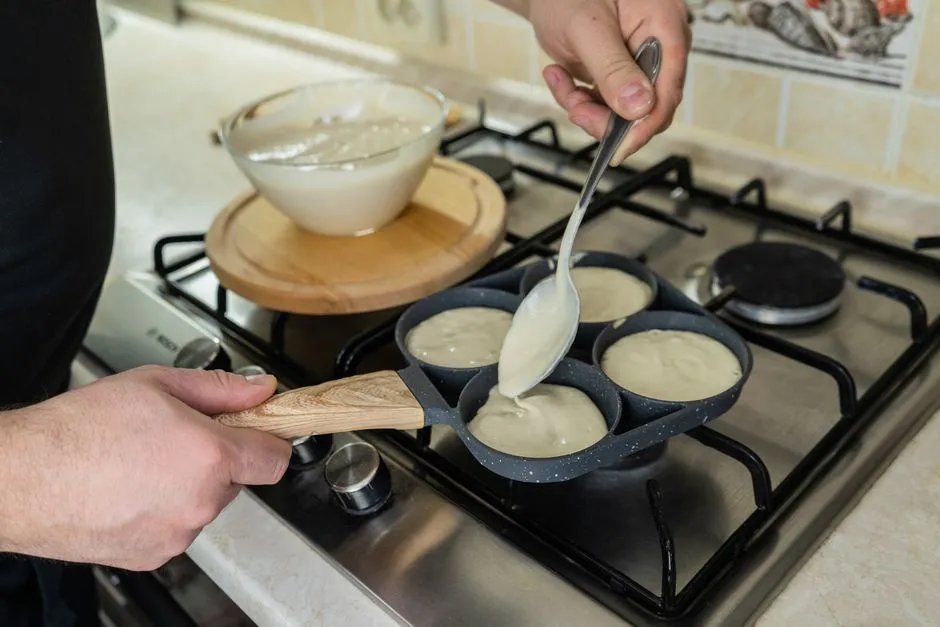
- Pancakes and waffles: scale flour, liquid, egg, fat, sugar, salt, and leavener together. Keep each pancake or waffle the original size, so per-piece cooking cues remain useful.
- French toast: reduce bread and custard together. Choose a dish just large enough to coat the slices, or half the custard will stay on the bottom.
- Muffins and quick breads: match the reduced batter to a smaller pan or fewer wells, then judge doneness rather than blindly dividing the time.
- Frittatas and breakfast casseroles: preserve the approximate depth. A thin layer sets faster and dries sooner than the original.
- Yeast doughs: the ingredient factor still works, but a very small dough may not engage a stand mixer properly. Hand mixing may be simpler.
The site’s small-batch buttermilk pancakes already solve the ratios for a two-person yield. When a tested small-batch recipe exists, use it before reverse-engineering a family batch.
How do you halve one egg?
Crack the egg into a small bowl, whisk until the white and yolk are evenly combined, then divide the mixture. A large egg out of its shell weighs about 50 g, so half is about 25 g; King Arthur Baking also gives roughly 14 g for a yolk and 35 g for a white when a recipe separates them. (King Arthur Baking)
The scale method is straightforward:
- Put a bowl on the scale and tare it to zero.
- Crack in the egg and note the actual weight.
- Whisk until uniform.
- Transfer half the measured weight to the recipe.
If the egg weighs 52 g, use 26 g, not an automatic 25 g. No scale? The Nebraska Extension guide uses 2 tablespoons of whisked large egg as a practical half. That is less exact because eggs vary and tablespoons are not weighed, but it is better than trying to split the white and yolk by sight.
For scrambled eggs or an omelet, there is no need to create half an egg merely to obey a large recipe. Use a sensible whole-egg count for two people and adjust the remaining ingredients around it. The half-egg method matters most in batters where egg is part of the liquid and structure.
Should baking powder and baking soda be rounded?
Multiply leaveners by the same factor as the flour. Half of 1 teaspoon is 1/2 teaspoon; one-third is about 1/3 teaspoon. Do not leave a full spoonful because the number looks small, and do not round a small amount down to nothing.
Measuring spoons handle halves and quarters well. When the result falls below the smallest spoon you own, a scale must be sensitive enough to register that ingredient reliably; many everyday kitchen scales are not. At that point, use a tested small-batch recipe, make a slightly larger batch, or freeze suitable extras. Guessing at a dusting of baking soda can change browning, flavour, and rise.
Salt and strong spices deserve the same care, but they offer a little more flexibility in dishes seasoned at the end. For a batter, divide the listed amount. For potatoes or eggs, begin with the calculated amount and adjust only after tasting cooked food safely.
Pick a pan that fits the new amount
On the stovetop, the useful question is how much of the surface the food occupies.
Pancakes need enough open area to flip without touching. Hash browns and potatoes need a loose layer so steam can escape. Scrambled eggs need enough contact with the pan to form soft curds without spreading into a paper-thin film. If half a recipe barely covers a large griddle, move to a smaller skillet rather than chasing it around a cold perimeter.
For baked dishes, compare bottom area when the pans have similar shapes and depths. A 9 × 9-inch square pan has 81 square inches of bottom area. Half is 40.5 square inches; an 8.5 × 4.5-inch loaf pan has 38.25 square inches, which is close. King Arthur Baking uses that exact comparison in its recipe-reduction guidance.
This is an approximation, not permission to fill any pan to the rim. Check the vessel’s capacity and leave room for the food to rise, bubble, or expand. For a breakfast casserole, maintaining depth is more useful than matching the area perfectly. Multiply the original bottom area by the scale factor, choose the closest sensible vessel, and compare the uncooked depth before baking.
Do temperature and cooking time get cut in half?
Keep the original heat setting. Halving ingredients does not mean baking at half the oven temperature or setting the burner to half its heat. The food still needs the same browning, steam, protein setting, or leavening conditions.
Cooking time depends on shape and method:
- A pancake of the same diameter and thickness cooks by the same visual cues, even if only three are in the batch.
- Two pieces of French toast take about the same time per side as four pieces cooked in separate rounds.
- Half a pot of oatmeal may heat sooner, especially in a smaller pan, so stir and watch consistency.
- A smaller or shallower baked dish may finish earlier because heat reaches its centre sooner.
- A half-full muffin pan does not require half the baking time; each filled cup remains the original size.
For a reduced bake, set a timer earlier than the original finish and use the recipe’s doneness cues. King Arthur notes there is no single formula for reduced baking time and recommends checking early instead of predicting an exact percentage. That is the right habit: the timer tells you when to look; colour, texture, and temperature tell you when the food is done.
For safety, FoodSafety.gov says egg dishes such as frittata and quiche should reach 160°F (71°C), while casseroles should reach 165°F (74°C). Raw eggs cooked on their own should have firm yolks and whites. A smaller portion does not lower those temperatures.
Plan the two-person breakfast so everything lands together
Small batches cook quickly, which is useful until the eggs finish while the potatoes are still firm. Work backwards from the slowest item.
- Start oven potatoes or another long-cooking side first. Our crispy oven breakfast potatoes give a tested order and doneness cues.
- Mix batter while the side cooks, but wait to combine wet and dry ingredients if the recipe says the leavener should be cooked promptly.
- Warm plates or set a low holding oven only if the finished food can wait without drying.
- Cook pancakes, waffles, French toast, or eggs last.
- Cut fruit and pour drinks during natural waiting time, not while a skillet needs attention.
For two people, one substantial item plus one simple side is often enough: pancakes and fruit, eggs and toast, or potatoes with a small frittata. A crowded brunch menu creates more leftover ingredients than a large recipe would have done.
When should you not scale down?
Do not halve a recipe merely because leftovers exist. Some foods are easier to cook at full size and portion later. Freezer-friendly muffins, uniced quick bread, waffles, and cooked breakfast potatoes can make a future morning easier, provided the specific recipe stores and reheats well.
Use the full recipe when:
- dividing a tiny amount of leavener or egg would be unreliable;
- the smallest pan you own still makes the reduced food too shallow;
- a mixer cannot reach the small quantity;
- the recipe depends on a minimum batch size for blending or kneading;
- the extra portions can be frozen without a quality problem.
Use a dedicated two-serving recipe when precision matters and you do not want to troubleshoot. Scaling is a tool, not a test of character. The best breakfast for two is the one that gives both plates a proper portion and leaves the cook with no mysterious quarter-egg to explain.